
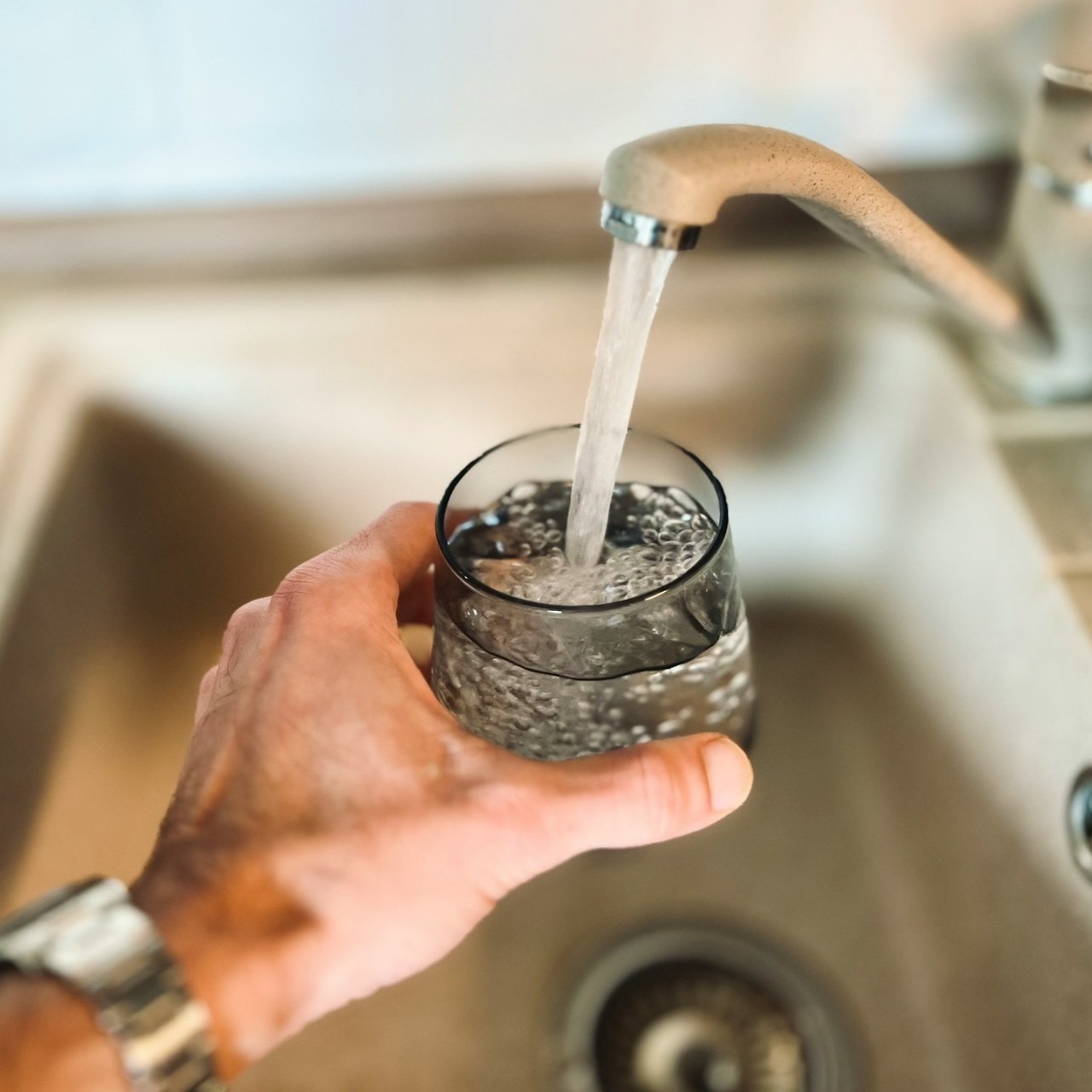
Gilbert tap water is safe to drink, but it has a few characteristics that catch people off guard. The chlorine smell, the white crust on taps and showerheads, the slightly flat taste: none of it is a sign something’s wrong. It’s just what you get when your water travels a long way through mineral-rich geology before it reaches your kitchen. Here’s what’s actually going on and what you can do about it.
Where Does Gilbert’s Water Come From?
Gilbert draws from a blended supply: the Salt River Project, the Central Arizona Project (which brings Colorado River water into the Valley), local groundwater wells, and reclaimed water. According to the Town’s own water supply data, CAP/Colorado River water makes up roughly 41% of the portfolio, SRP surface water about 40%, groundwater around 4%, and reclaimed water the remaining 15%, mostly used for irrigation and non-potable purposes rather than drinking water.
The Salt River Project supplies surface water pulled from the Salt River and Verde River watersheds, feeding a network of reservoirs northeast of the Valley. The Central Arizona Project brings Colorado River water through a 336-mile canal into central and southern Arizona. Local groundwater wells supplement supply during peak summer demand, when temperatures regularly push past 110°F and usage spikes across the East Valley.
Gilbert processes this blended supply through two treatment facilities: the North Water Treatment Plant, which treats SRP water, and the Santan Vista Water Treatment Plant, which treats CAP/Colorado River water. The Town publishes an annual Consumer Confidence Report detailing what’s in the water and at what levels.
The blend of sources matters because surface water and groundwater carry different mineral profiles. Mix Colorado River water, which is naturally high in dissolved minerals, with local groundwater that has picked up additional minerals from Arizona’s geology, and you end up with water that is noticeably hard and mineral-rich straight out of the tap.
The blend also shifts seasonally. During summer when demand peaks, Gilbert draws more heavily on groundwater to supplement surface water supply. Groundwater tends to carry higher mineral concentrations than surface water, which is one reason the flat, slightly salty taste can feel more pronounced through the hottest months of the year.
Why Does Gilbert Tap Water Taste Like Chlorine?
Chlorine is the primary disinfectant used in Gilbert’s water treatment process. It’s doing its job, keeping the water safe as it travels through miles of distribution pipes to your tap. But at typical municipal treatment levels it produces a noticeable bleach-like taste and smell that is the single most common complaint from Gilbert residents.
If the taste is more salty or bitter than bleachy, that’s the minerals. Gilbert’s water averages around 8 to 10 grains per gallon according to the Town’s own figures, with seasonal variation that can push levels higher, hard enough that most households benefit from a softener. That mineral content, mostly calcium and magnesium, is what leaves scale on your shower screens, crusts up your kettle, and gives the water that flat, slightly salty taste many residents notice.
The two issues, chlorine taste and mineral taste, are separate problems with separate solutions.
Is Gilbert Tap Water Safe to Drink?
Yes. Gilbert’s tap water meets all enforceable EPA standards. The Town’s water utilities have an excellent compliance record and the annual Consumer Confidence Report is publicly available if you want to check the numbers yourself.
That said, it’s worth understanding how EPA standards work. The EPA sets two thresholds for each contaminant. The MCLG is the health-based goal, the level below which no known health effects are expected over a lifetime. The MCL is the enforceable legal limit, which is sometimes set higher than the MCLG because treatment costs and technology factor in. Your water can pass every legal test and still contain some contaminants above the EPA’s ideal health target.
For most healthy adults, Gilbert’s tap water poses no acute health risk. If you have young children, are pregnant, or have specific health vulnerabilities, it’s worth looking more closely at filtration options.
If any of that gives you pause, the good news is that the fixes are straightforward.
What Can You Do About It?
Chlorine Taste and Smell
A simple activated carbon filter at the kitchen tap will remove chlorine taste and odor effectively. This can be a countertop unit, an under-sink filter, or a filtered pitcher. For whole-house chlorine reduction, a whole house water filtration system handles it at the point of entry so every tap in the home benefits.
Hard Water and Scale
A water softener exchanges the calcium and magnesium ions responsible for hardness with sodium or potassium ions. This eliminates scale buildup on fixtures and appliances, extends the life of your water heater, dishwasher, and washing machine, and removes the flat mineral taste from your drinking water.
Many Gilbert households run a whole-house softener on the main line with a carbon filter at the kitchen tap. That combination handles both the hardness and the chlorine taste in one setup.
Broader Contaminant Reduction
If you want to go further and reduce a broader range of dissolved contaminants, including disinfection byproducts and other compounds that carbon filters and softeners don’t address, a reverse osmosis system is the most effective option for drinking and cooking water. RO systems filter water through a semi-permeable membrane, removing a wide range of dissolved contaminants in a single pass.
Not Sure What Your Home Needs?
The right solution depends on what’s bothering you most. If it’s chlorine taste only, a carbon filter is enough. If it’s scale on every fixture and appliance, a water softener makes the biggest difference. If you want cleaner drinking water across the board, an RO system at the kitchen tap is worth considering.
At Evolution Plumbing we install and service water softeners, RO systems, and whole-house filtration across Gilbert and the East Valley. Call us or book online for a free estimate and we’ll recommend the right setup for your home.
