
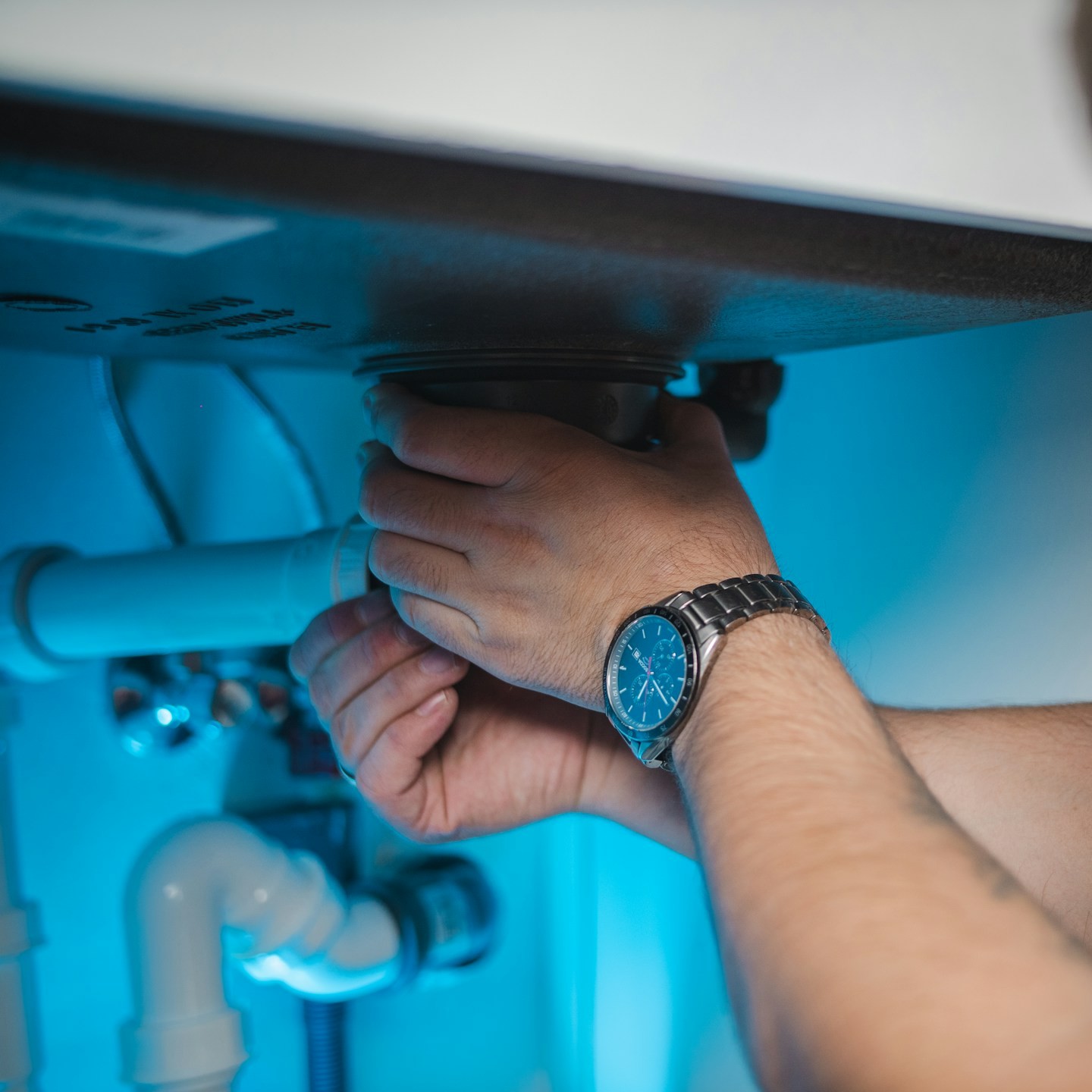
A leak’s worth checking if your water bill jumps for no obvious reason, you find damp ground near the meter, or you’re seeing water where it shouldn’t be.
Good news: you can get a pretty useful answer without tearing anything apart. Take a meter reading, make sure nothing in the house or yard uses water for at least an hour, then check it again. If the reading moves, water’s going somewhere.
From there, the main shutoff narrows down whether the problem’s in the house, in the yard, or somewhere between the meter and the home.
Key Takeaways
- If the leak indicator moves while nothing in the house or yard is using water, you’ve got flow somewhere.
- Once the meter confirms it, rule out toilets before you start worrying about a buried leak.
- The main shutoff helps narrow down which part of the plumbing you’re dealing with.
- If the test points toward the meter or street side, call Gilbert first. If it points toward your private plumbing, that’s usually where we come in.
How to Read Your Water Meter
Your meter usually sits in an in-ground box near the sidewalk or front property line. Open the box carefully, clear any dirt or condensation off the face, and make sure you’re looking at the right meter. Not sure? Compare the meter number with the one on your water account.
The row of digits across the face is your total usage. Read it left to right, like an odometer.
You’ll also see a small leak indicator. Depending on the meter, it may look like a triangle, star, wheel, or small spinning disc. That’s the part to watch when nothing should be using water. If it’s moving, water’s moving.
Signs Your Water Meter May Be Showing a Leak
A leak doesn’t always leave a puddle. Sometimes the first sign is a water bill that keeps creeping up. Sometimes it’s a meter that won’t sit still. Sometimes it’s a soggy patch in the yard that never dries.
The point is separating an actual continuous flow from normal water use you forgot about.
The Dial Test: Meter Movement Without Water Use
The leak indicator gives you a quick first check. Make sure nothing’s using water, then watch it. If it’s turning, there’s flow somewhere in the system. If the movement’s too slow to catch by eye, take a photo and compare it again after 20 or 30 minutes.
Just make sure you’ve accounted for anything that runs automatically. That’s the trap. Ice makers refill on their own. Softeners regenerate on a timer. Irrigation zones fire automatically. Evaporative coolers top themselves up. A spinning indicator only tells you something useful once you’ve ruled those out.
Visible and Hidden Signs Around the Meter
Standing water in the meter box can point to a leak. Don’t jump straight to that conclusion, though. Rain, irrigation runoff, and poor drainage fill the box too. If you want to check it, drain or bail the water out, leave the irrigation off, and look again later when there hasn’t been any rain.
A slow leak may never make a puddle at all. Water soaks straight into the ground and disappears. That’s where the meter helps. The soil looks fine while the usage keeps climbing.
Where Water Meter Leaks Show Up Around Gilbert Homes
Around Gilbert homes, we start with the obvious connections: the fittings at the meter, the private water line heading toward the house, and any irrigation line or valve manifold that tees off nearby.
Irrigation’s a big one out here. A cracked underground line or leaking valve runs for a long time without making a dramatic mess. Sometimes all you get is a soft patch of dirt, a wet spot that won’t dry, or a water bill that keeps inching up.
The private service line between the meter and the house does the same thing. Sometimes the leak surfaces. Sometimes the water disappears into the soil and the meter’s the only thing telling on it.
Once the line reaches the house, slab leaks and hidden supply-line leaks become another possibility. The one-hour meter test won’t tell you where a slab leak is. It tells us water’s moving before we start chasing the source. That’s where leak detection equipment earns its keep, finding the exact point without opening up the slab on a guess.
And don’t forget the simple stuff. Hose bibs, irrigation valves, toilets, and fixtures waste plenty of water without looking like an emergency.
How to Test for a Water Leak With Your Meter
The test itself is simple. The trick is getting a clean result.
Tools You’ll Need
You don’t need much. A flashlight helps, because meter boxes are usually dark. Your phone’s useful for taking a photo of the first reading so you don’t have to trust your memory. Gloves aren’t a bad idea if the box is full of dirt or bugs.
And grab some food coloring or toilet dye tabs while you’re at it. Toilets are the easiest continuous leak to rule out before anybody starts worrying about a buried pipe.
The One-Hour Leak Detection Test
Turn off every faucet inside and out. Stop the dishwasher and washing machine. Turn off the irrigation controller. Make sure the ice maker, softener, and evaporative cooler aren’t about to draw water.
Take a photo of the meter reading and the leak indicator. Then leave the water alone for at least an hour. Overnight works even better if you can pull it off without anybody flushing a toilet, running a faucet, or starting an appliance.
Check the meter again. If the reading changed, water moved through the meter while nothing should’ve been using it.
Now check the toilets before you go looking underground. Put a few drops of food coloring or a dye tab into the tank and leave it alone for about 30 minutes without flushing. If color shows up in the bowl, the flapper’s leaking. That may be your whole problem.
How to Tell Whether the Leak Is Before or After Your Main Shutoff
If the meter test confirms flow and the toilets check out, next stop is the main shutoff. On a lot of slab-on-grade Gilbert homes, you’ll find it on an exterior wall near the front of the house or in a valve box between the meter and the home.
Close it fully, then watch the meter again. If the leak indicator stops, you’ve narrowed the leak to plumbing that’s downstream of that shutoff. Exactly what’s included depends on where the home’s irrigation and other branches tie into the system.
If the indicator keeps moving, the leak may be between the meter and the shutoff, at the meter connection, or the shutoff isn’t sealing all the way. Old gate valves are bad about that.
Before you decide where the leak is, open an indoor faucet and make sure the shutoff actually stopped the water. That one check keeps you from blaming the wrong side of the system.
Who Pays for a Leaking Water Meter in Gilbert?
Where the leak sits matters. If the test points toward the meter itself or the street side, call Gilbert Water Services before you pay anybody to start digging. If the leak’s on the private plumbing side, that’s usually the homeowner’s repair.
The exact ownership line varies depending on the setup, so don’t guess. Gilbert can confirm what belongs to them and what belongs to you. That matters even more in apartments, master-metered communities, or properties with submeters, where the ownership setup can be different.
How to Report and Document a Meter Leak
Take pictures before anything gets disturbed. Photograph the meter box, the meter face, the reading, and any standing water or wet ground around it. Write down the date and time too.
If the leak looks like it’s on the utility side, contact Gilbert and give them the meter reading along with what you already tested. Ask them to confirm whether the leak point is theirs or yours before anybody starts digging around the meter.
And don’t dig around buried water lines until you know what’s underneath. Arizona 811 needs to be contacted before excavation work so underground utilities can be marked.
Keep your photos and any reference number Gilbert gives you. If there’s ever a billing adjustment or ownership question later, you’ll be glad you did.
The Bottom Line
A water meter won’t tell you where the leak is. It’ll tell you whether water’s moving when it shouldn’t be. That’s enough to narrow things down fast.
Take the reading. Leave everything off. Check it again. Rule out the toilets. Then use the main shutoff to figure out which part of the system you’re dealing with.
If the test points to your side of the meter, give Evolution Plumbing & Misting a call. Tell us what the meter did, whether the toilets passed the dye test, and what happened when you closed the main shutoff. We’ll take it from there.
